

I was thrilled to speak to Kelly from Promising Pages earlier this year. This nonprofit leads the way when it comes to making use of book donations in Charlotte, and it was great for me to speak to a real life Director of an organization I’ve admired for a while!
I’m going to be uploading snippets of our conversation on social media and will also add these throughout this post, but here’s the transcript.
Tom: So I’m pleased to be joined this afternoon by Kelly of Promising Pages in Charlotte. It’s wonderful to have you with us, Kelly.
Kelly: Thank you so much for having me. I’m so glad that I randomly found you online and then now we’re connected. Yeah, yeah, it’s awesome.
Tom: One of my kind of favorite things you guys do is the Books on Break initiative. When I first discovered you, I really thought that was a great kind of process you had to work with kids. And how’s that going this year? I know school’s almost broken up.
Kelly: We’re in the thick of it right now. So, this year, so just, briefly Books on Break, is a set of free book fairs that we provide to Title I schools.
So, Title I could be different in different states, but, we,, use like the free and reduced lunch or it’s basically a poverty indicator. and,, so we are serving 23 Title I schools this year, elementary schools. And, we go in and do a free, a free kind of scholastic type book fair, with a lot, I mean, it’s, it’s so many books, over 70,000 books, went out of our warehouse for this, to just this one program.
And we’re serving over 12,700, elementary schoolers, so pre-K through fifth graders. And, each student gets to take home five books, to read over the summer. So it’s really addressing, you know, what we call the summer slide or summer learning loss, because we live in a book desert and, in Charlotte, we have, there are book deserts everywhere in the United States, but, there is a, a statistic for the United States that basically says that, you know, in low-income neighborhoods, there’s only one book for every 300 kids.
So when you think about that, like kids need to practice reading, they need to read over the summer so that they’re not suffering from that learning loss. But our kids can’t afford books, like books are so expensive. And when, you know, you’re trying to decide between, oh, how do I, do I feed my family with this money or, you know, get our car fixed or do we buy books? Well, that should never have to be a question.
And so, as a book bank, a regional book bank, that’s what we do is we provide free books. We do book access. So, for Books on Break, it is specifically for summer reading. It’s just so much fun to go in and do the book fairs. It’s like where we get a lot of our joy, you know, there it’s crazy, it’s a lot of work, but, you know, getting to actually see the kids get excited about the books and be kind of tearing around the room. It makes a lot of the other, the hard work worth it.
Reading Data
Tom: It’s great to hear. And I know you mentioned that research showed the most successful way to improve the reading levels was to physically be reading with the children. Is that something you’re kind of encouraging this year? And if so, how’d you go about it?
Kelly: Oh, yeah. I mean, everything we do is, so, you know, we, we try and steep all of our practices in research. In fact, we’ve changed a lot from the time our founder started this organization. We’re a completely different organization now because every year we get different types of research. And one of the things that we do is book choice.
We serve around 250 different nonprofits, with free books every year. And one of the things that we ask them is, we really want you to let the kids choose the books that we give you. There is too much data to show that kids are more likely to read the books they choose themselves. So, we kind of feel like it’s a waste if you’re just handing a kid a book. We really want to let them choose. But, the other thing is, you know, if books aren’t in children’s homes, they can’t practice, there’s no reading together, like it’s so valuable for parents to build a read with, and, and to kids like from birth.
I was just talking to a med student. We’re about to start a reading program in a NICU. They need the rich language of picture books and children’s books. The more books children have in their homes, the more literacy opportunities they have, the more opportunity to hear language. And it really sets them up for success in the future if they have books and they can practice reading. There are some pretty staggering illiteracy statistics that would shock you about how much money the United States loses every year because of illiteracy, and how much is gained by being literate. So I encourage you to go look them up. I don’t want to bore your listeners.
Tom: Well, that’s one reason I wanted to talk to you, Kelly, because you’re full of stats. You’re like the stats woman for literacy.
Kelly: Well, you gotta give the hearts and the butterflies, but you know, some people need that, need those hard numbers. And you can’t really argue with them.
Tom: Exactly. Yeah. When I used to work in the publishing industry, when we made children’s books and we were trying to encourage parents to read with kids, one thing I learned was that that parent-child bond is something that’s really established during story time. And everyone’s always said to set aside 20 minutes every evening for story time because it’s just an invaluable kind of bonding for the parents as well.
Kelly: Yep. And so pediatricians, and I’m talking about another nonprofit right now, but in well care visits, they actually teach parents how to do that. So, we partner with them by putting additional books in the waiting rooms of clinics so that families can be reading, whenever they’re waiting. So, reading is appropriate everywhere unless you’re driving and then that ‘s audio books.
Please don’t read and drive. I did not, I did not say that. I cannot be sued!
Popular Books at the Moment
Tom: And I know you mentioned it’s great for the kids to choose books they’re interested in because that’s going to engage them and, you know, get them actually interested in the subject matter. What are like the most popular books you’re seeing them choose this summer?
Kelly: So the, what we’ve been seeing, so the last, for the last five years, Dogman has been the king. It is consistent from first graders all the way up to fifth graders.
People are like, do you have any Dogman? And kids will literally spend their entire time in the book fair looking for Dogman books. And it’s just like, there are other books out there, but, you know, I have a really terrible analogy about graphic novels and books. Dogman’s a good book, but even the Diary of a Wimpy Kid books, it’s like the low hanging fruit, right? It’s like the thing that’s going to get kids hooked on books and then they’re going to read everything in that series they can get their hands on, then they’re going to start reading more complicated texts.
They’re going to grow as a reader, their tastes are going to mature. So, it’s really important that they don’t judge their child’s choices, right? I have twin boys, they’re 17. So they’re about to go into their senior year and one of them hated to read, but he was very interested in manga books and this was like years and years ago. And it was really hard to find them. So I was like, okay, I don’t really know anything about manga, but we’re going to go get you some manga books. And the child would stay up till three o’clock in the morning reading. and then he started reading more complicated texts and he was reading like, you know, military histories and all these crazy things. And, but it’s all because I had to put my own judgments about books away and let him choose.
And, then he flourished. So, you know, we have to do that as parents and teachers to teachers in the same way. There’s a lot of research on pleasure reading, and you can make kids read the things they need to read in school to become better readers, but they can also make the same amount of gains just by picking up what they want to read.
So if you’re reading a lot, so if you’re reading volume, you can almost get the same outcomes as if you were reading like leveled readers and all these other books that no kid picks up on their own because sucks the joy out of it. So we’re all about the pleasure reading here. All about it. We want kids to be excited!
Tom: Yeah. A bit off topic, but similar with music, actually, when I was being forced to play piano and stuff, when I was growing up, I don’t know what it was when I did like random French stuff I didn’t even know. But then I started playing guitar when I was 13. I was like, oh, I actually really like music. I’m actually kind of good at music. Like I just wasn’t playing the right instrument. So it’s kind of similar to that. And you weren’t playing the right music.
Kelly: Yeah. I did the same thing. I tried to learn guitar and I was playing like froggy one accordion and I’m like, but I like blues, you know? So I stopped playing guitar. It’s a perfect example. It’s the exact same thing. If you are not letting kids learn the things that they love, they’re going to lose interest and then you’ve lost them.
So by the time they’re in fourth and fifth grade, if they’re not really reading on grade level, you know, actually by third grade, if they’re not reading on grade level, they’re like four times more likely to drop out of high school. So, you know, give them what they want. They’ll read it. Just let them have it. Don’t judge. Don’t judge.
Yeah. So graphic novels and Dog Man. we’re still seeing a lot of Minecraft, too.
Book Donation Advice
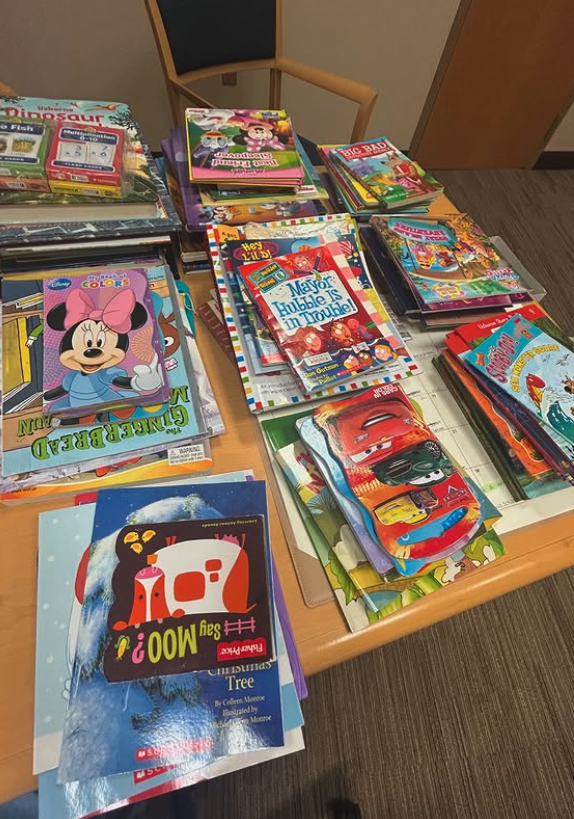
Tom: And then when it comes to your organization, collecting the books themselves, what are the do’s and don’ts of book donations? Just like common issues you find with books that you can’t use, and stuff maybe the way people have donated, just if you can go through that a little bit.
Kelly: Yeah. So, it also depends on the receptacles that people are, you know, collecting books and, you know, like a lot of people will see those big metal bins out in random areas of parking lots on the side of construction.
Like dropping them and it’s like clothes and books, right? Like that always we’ll get donations like that from one of our partners. And it’s like, we find the most random things in the boxes and… the books are just dirty.
So first of all, I would say, take care of your books, like teach your kids how to actually care for their books because books have a life after your home, hopefully.
I’ll go through and I’ll say like, don’t dog ear these books. Like I, I act like they’ve just murdered someone, you know, I’m like, don’t you do that to this book, you know? But just teach your children to take care of the books.
Like water damaged books, moldy books, we don’t want those. I’m not even sure we can recycle them. We might actually have to just throw them away. But we try to save as many books as possible. We cannot clean molds, you know? So please don’t give us those things.
Magazines are great, but you know what, they’re not books. Every organization like ours is going to have a different kind of criteria.
But you know, don’t put crayons in your books because little kids are just gonna be all over those things. And God love you people… nobody wants your encyclopedias. A pulper wants them!
There are actually a lot of great book crafts that you can do with encyclopedias. Like you can make all kinds of things out of them. We’ll sometimes take damaged books with broken spines and I will cut the spines off. We will pull the whole book apart. We clean it up. We laminate all the pages and then we rebind it. And then we give them to teachers who work with children with disabilities and special needs. We call them adaptive books. So they’re actually able to adapt those books and do things to them. We glue buttons in them so that the kids with fine motor skill issues can turn the pages more easily.
And so we try to really use everything that we get. But for the most part though, it’s really water damage and mold. Just teach your kids how to take care of them.
Tom: I’m quite interested in that. Like you using the buttons and stuff to decorate books. Is that something you guys are doing yourselves?
Kelly: Yes, we don’t have a lot of time to do it. I used to work in a private special needs school. So, I see how children who might have neurological issues or fine motor skill issues, even gross motor skill issues, have a hard time turning the pages. So, they can rip a lot of books. So books don’t last as long with younger kids and be kids who, you know, just have those.
So sometimes what we’ll do is if there’s a board book, which are the hard books, like all the way through, we’ll put a little button, or a big button or something on every single page so that there’s just a little bit of space in between the pages so that they can easily turn those pages. It was even just talking to this med student about this NICU project that I just mentioned. They have to hold the babies and turn the pages at the same time. And I was like, oh, I can insert tabs on these books so that you guys can easily grab them and turn the pages without dropping the baby. We can’t drop the baby!
So, it’s just little things like that, but you can do all kinds of adaptations, but, it’s really more about, we just give the teacher the kind of clean slate, you know, and they can clean them because if they’re laminated, they can clean them, and keep them sanitary.
Anyway, it’s just something that we provide, but we usually have to make it a volunteer project just because I’d spend all my time doing that. I’d get a lamination high, just like the laminator constantly going! But it’s a great thing to be able to save a book and then give it, you know, a special life after that.
The National Book Access Association
Tom: I know you mentioned you’re a founding member of the national book access association, which I haven’t heard of before. So if you want to just explain a bit more about that and what that does, that’d be awesome.
Kelly: Yeah. So, the national book access association came out of a group of nonprofits, a lot of us are book banks, but not all of us, but we all distribute children’s books, either new or gently used. So not all of our members collect donated books. Some of them just strictly buy books, but, we all have slightly different ways that we do what we do, and we’re all across the nation and we just started coming together during COVID over zoom.
And we were going to these other conferences and they were about literacy, but they weren’t actually about what we do about book giveaway programs. And so I was like, I want to have our own conference so that we can get together and share best practices. And, we can really dig, how do you process a book? How do you sort, how do you do all these different things? There’s all these processes that we’re constantly revising based on our space or whatever the issue is.
And so, so we had our first conference and then, we decided, you know, we all needed to be an organization, a membership organization. So I think we’re pushing about 400 members now. So, and we’re all across the U S. And it has been really amazing to be able to share what we do with like-minded people and, and advance what we’re doing and share resources so that we don’t have to reinvent the wheel. Because most of us are small staff. Like I have, we’re five and a half people at Promising Pages. There are other organizations that are 40 people, and they have these huge million dollar budgets and I’m like, good for you! I’m a little jealous. But I’m very happy for you. I would like a couple of million dollars budget, but we’ve learned so much from them about wholesaling so we’re able to buy books now at a much cheaper rate than if we were trying to go on Amazon and buying them at retail.
So, very similar to your website. That was such a nice thing to see when I found your website and I was like, they actually have programming information about us on here. I was so impressed. I was like, wow, they didn’t just like, you know, run a search and then just throw it up there, like using AI, like there was actual real information there. So, so thank you. We appreciate it! I actually mentioned you to my colleagues. I was like, Hey, by the way, there’s this guy who has this website. So it’s really helpful, especially those of us who strictly want to rehome books.
There’s a big difference between people who are getting donated books and then reselling them to put into other programming. You know, it’s great. I’m so glad that they can do that.
But like, we actually want to keep the books where we are and stay in our County and give them back to children. So, the more organizations like ours that can receive those books, the better, the more children are getting those books into their hands instead of them being pulped for money. A lot of places pull books and it’s just like, we just don’t want to do that.
Tom: It’s maybe telling that the interactions I’ve had with those people are slightly more negative than the interactions I’ve had with people from your world, which is kind of on brand.
Kelly: Yeah. Yeah. But you know, everyone’s struggling for funding. So I understand. I just wish they could find something else to fuel their funding because we could really use those books. And some of them do share, some of them do share with us, you know, so I’ll give them that.
Kelly’s Personal Highlights
Tom: And for yourself, any personal highlights from your time at Promising Pages, like you can be a bit self-indulgent here. What was like, like a really cool moment you had?
Kelly: Well, there’s so many, and this wasn’t actually my story. This was something that was told to us during COVID.
We were distributing books through feeding lines and through like one that could get books to families. But, there was a really lovely moment when, one of the folks, it was through a church and, this family was, I guess, new to the country and the mother was coming up and this volunteer was like, Hey, you can get books. At the time we didn’t know how COVID was really spread on a surface. And so we were cleaning books and then we all were all gloved up and masked up. And so the stack of books in this brown paper bag got given to this mom based on the age of her kids.
When she came back a week later she asked the volunteer to come over. And she was like, I don’t think you realize I opened up that brown paper bag with the books in it. And inside of it was a book that I had loved from childhood. It was my favorite childhood book. And I lost it in a fire, our house burned down and there it was in this bag just by happenstance. It was the exact book, just not her physical copy because it was burned in the fire, that would have been a miracle. And I don’t know how that would have happened, but now she was now able to read her favorite childhood book to her children.
So she was very teary. And, so it’s, you know, and that’s kind of a mushy moment.
There’s so many things that get passed through story and so it’s just such a powerful thing. I wish more people really embraced it for the true power that it has. So, it could change the world if more people actually just sat down and read a book with their kids, just maybe not Dog Man right away, you know, you’d start with dog man, but you’ve got to progress.
Tom: Yeah. Yeah. When they’re babies, you start with Dog Man.
Kelly: Yeah, yeah, exactly.
Tom: On that wonderful note, thank you so much for taking the time to chat with me, Kelly. It’s been great getting to know more about Promising Pages.
Kelly: Absolutely. Thanks for doing what you do. We appreciate you advocating for us!